Sales and marketing technologies have come a long way in a short time, but they still have miles to go before teams are freed from the manual, error-prone processes that plague them. Of these, data onboarding has been one of the most difficult to solve through automation.
What is data onboarding? At its most basic, it is the process of getting external data — spreadsheets of leads from events, purchased lists, partner data feeds, third-party enrichment sources — into your marketing and sales automation systems cleanly, completely, and consistently. While list loading is probably the most commonly conceived use case, data onboarding comprises a wide range of other sources and activities that, not coincidentally, also contribute to its complexity.
In this blog series, we cover step-by-step instructions on how to deploy an automated data onboarding process, including all the different tasks that can be automated. Not all steps may be relevant to your situation, so just implement the subset of tasks that makes sense for your business.
List loading is commonly a process that applies to B2B companies. B2C companies have similar processes for onboarding purchased leads, and the fundamental steps and technology involved are the same. The differences are:
B2B processes tend to be more complex and have more steps involved than B2C processes. B2C processes tend to deal with higher volume and higher frequency, as well as more importing sources.
For this discussion we will focus on the B2B process, but much of it applies to B2C as well.
Why is data onboarding so hard to automate?
Things get complicated when multiple groups are onboarding lead data with no consistent standards for list structure and field values. Further exacerbating the problem is the typical staffing assignment for these tasks, which usually falls into junior, inexperienced hands — hands that are prone to skipping essential steps like standardization, normalization, and deduplication.
It's worth noting that companies tend to make their most junior team members responsible for list loading. And they often skip steps in the process like normalizing the data and cleaning up formats. These two factors often contribute to dirty data that affects many processes down the road, like lead scoring, lead routing, and segmentation.
Marketing and sales operations teams typically use a collection of point solutions to accomplish the list loading process. To automate the entire end-to-end process on a single technology platform requires a highly flexible platform with extensive connectivity to different systems and third-party services.
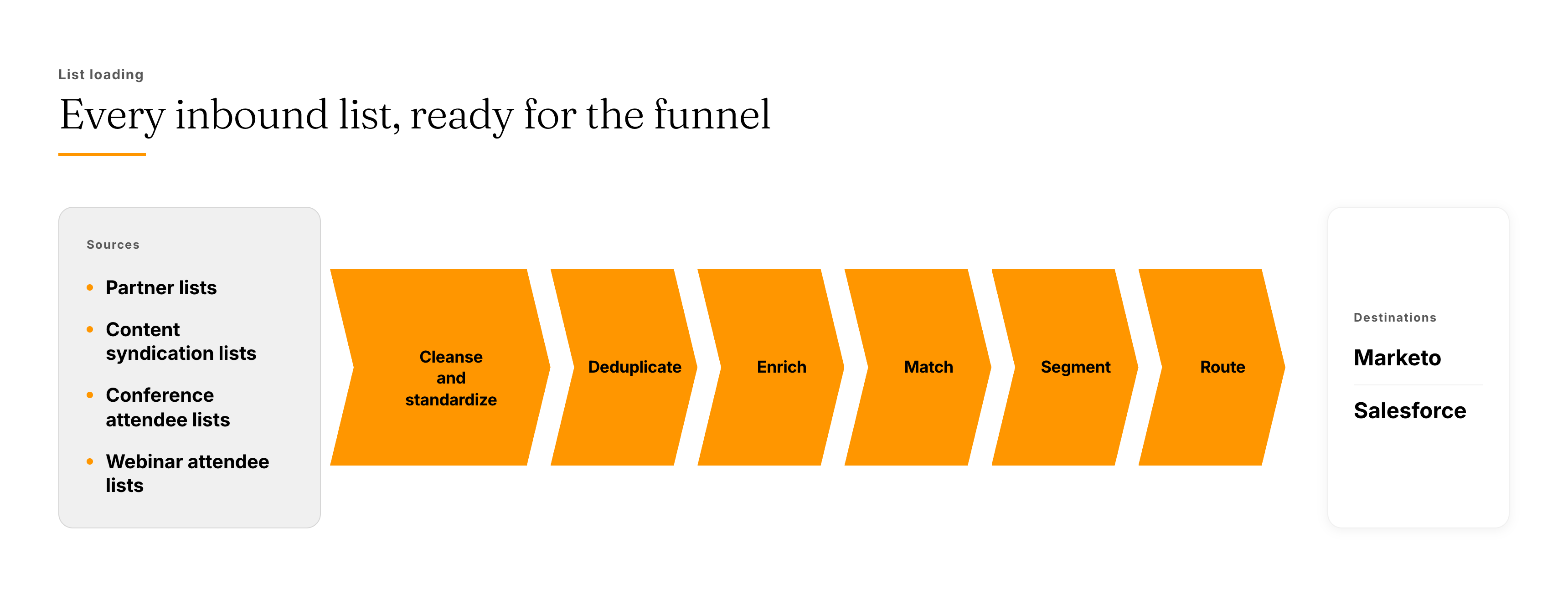
The diagram below illustrates common steps involved in a typical list loading process, which can include:
- Preparing data
- Making decisions about the data
- Taking action on the data
Why manual fixes and consultancies don't work
In response to these challenges, many companies resort to hiring expensive data onboarding consultancies that charge upwards of $50,000 to $100,000 a year or more. However, these investments often yield no substantial improvements, no matter how well they document their processes. The problem lies in the sheer scale of today's data streams: as the volume and speed of data increase, no amount of manual procedures can keep pace.
The cost of building it yourself is equally prohibitive. Developing your own middleware often requires at least $250,000 in technology investments and another $250,000 in consulting services, and typically requires a minimum of nine months to complete.
Now add the personnel costs. While most businesses spend far more than four hours a week on manual data onboarding, using $75 as the hourly labor cost, the cost to manually onboard data in-house can easily exceed $15,000 a year — not including IT support.
As this simple back-of-the-envelope calculation shows, a purpose-built automation solution can reduce your data onboarding costs by 75%.
What automation actually replaces
Modern data onboarding platforms like Openprise replace the entire collection of point solutions that ops teams typically stitch together. Openprise connects to 300+ pre-built integrations across CRM, marketing automation, data enrichment, and warehouse systems, so there is no custom middleware to build or maintain.
The platform handles data onboarding as part of a broader AI and data orchestration layer — meaning the same system that loads and cleans your lists also handles enrichment, deduplication, scoring, routing, and campaign assignment. You define the business rules once. Openprise runs them automatically, at any volume, on any schedule.
What results look like in practice
Zendesk used Openprise to automate data cleansing, enrichment, deduplication, and standardization across their onboarding process. The outcome was a 25% gain in data cleansing efficiency, a 25% improvement in sales rep efficiency, hundreds of thousands of dollars in incremental revenue from better targeting, and high six-figure savings from productivity improvements. Roberto Fernández Madero, Manager of Marketing Operations at Zendesk, put it simply: "Since we've automated all the data standardization and list loading processes, there's nothing to do except check the headers and upload the list."
Armanino, one of the 25 largest accounting and consulting firms in the U.S., reduced time spent per list upload by 40%. Their automated list loading process now runs 24/7 regardless of staff availability.
At higher volumes, Cord Blood Registry processed over three million leads with zero manual intervention using Openprise — every record validated and actioned in real time, with low-quality leads filtered before reaching campaigns.
If the clear ROI value isn't enough to sway you, the additional revenue from faster, higher quality leads might. At the least, you owe it to yourself and your team to explore it further.