Product-led growth sounds like the cleanest GTM strategy ever invented.
Put your product on the internet. Let people try it. Watch them fall in love. Paid accounts appear. Sales wakes up to a neat list of enterprise opportunities, each one enriched, scored, and assigned to the right rep.
Adorable.
What usually happens is that the product generates thousands, sometimes millions, of users and behavioral signals. Half the users sign up with personal email addresses. Product data lives in Snowflake. Enterprise accounts live in Salesforce. Marketing engagement lives in Marketo. Sales wants to know whether catmom1987@gmail.com works at a Fortune 500 company.
The product generated demand. Your GTM stack lost the forwarding address.
That is both the promise and the massive operational problem of an enterprise product-led growth motion. Your product can become one of your best acquisition channels and your strongest source of pipeline. But only IF you can identify the users, connect them to companies, spot account-level traction, and act before the signal goes cold.
TL;DR
Product-led growth, or PLG, is a go-to-market strategy where the product drives acquisition, activation, conversion, retention, and expansion.
Users experience value before talking to sales or making a major purchasing commitment. Freemium plans, free trials, self-service onboarding, product usage signals, and in-product upgrade paths are all common parts of a PLG motion.
But a free plan does not automatically make a company product-led. That is like putting a treadmill in your garage and calling your house a gym.
Successful PLG motions require product, marketing, sales, customer success, and Ops to organize around what users are doing inside the product. At scale, it also requires a data layer that can answer one important question: Who is actually ready to buy from us?
What is product-led growth?
Product-led growth is a business strategy where the product is the primary driver of customer acquisition, activation, conversion, retention, and expansion.
In a PLG model, users typically discover the product, sign up on their own, and experience its value before a traditional sales conversation begins.
The sequence is simple: Use the product. Get value. Then talk about money.
That is different from the classic enterprise software experience, where a buyer completes a form, schedules a discovery call, attends a demo, invites six stakeholders to another demo, and spends three weeks discussing implementation before anyone lets them touch the product.
PLG moves the experience to the front of the journey.
That does not mean marketing and sales get to pack up and go home. Marketing still attracts the right users. Sales still handles enterprise expansion, procurement, and executive alignment. Customer success still supports adoption. Ops still connects the systems and signals that make the motion work.
The product becomes the starting point, not the entire GTM organization.
Why is product-led growth built for SaaS?
PLG fits SaaS because software can be distributed, experienced, measured, and expanded with very little friction.
A user can create an account in seconds. The company can see whether that user completed onboarding, activated an important feature, invited coworkers, returned the next day, or hit a usage limit. That gives SaaS companies something traditional funnels struggle to produce: direct evidence of value and buyer intent.
Buyers want to evaluate software themselves
B2B buyers know how to fill out a demo form. Most just don't want to anymore.
Many would rather explore the product for themselves and answer a few questions on their own:
- Can it solve my problem?
- Is it painful to use?
- Can I set it up without opening a support ticket?
- Will my coworkers use it?
- Is the “easy integration” easy, or is that a creative interpretation?
A self-service experience lets buyers investigate your solution before involving a salesperson in the process.
Product behavior is a stronger signal than a form fill
A form fill tells you someone wanted a white paper.
Product signals can tell you that eight people from the same company signed up, activated an important feature, invited three teammates, and used the product every day this week.
One of those situations suggests buying intent. The other suggests that your guide had a good title.
The product can distribute itself
Strong PLG products build exposure into the experience.
A user shares a Dropbox folder. Sends a Calendly link. Invites a coworker to Slack. Shares a design from Canva. The recipient experiences the product while accomplishing something useful. Nobody has to download The definitive guide to sending a calendar invitation.
The product does the introduction.
PLG vs. sales-led vs. marketing-led growth
Product-led, sales-led, and marketing-led growth describe which part of the company creates the initial momentum in the customer journey. Most mature SaaS companies eventually combine all three.
Sales-led growth
Sales-led growth relies on salespeople to guide buyers through discovery, evaluation, negotiation, and purchase.
It works well for products with:
- High contract values
- Complicated implementations
- Significant customization
- Multiple executive stakeholders
- Heavy security or procurement requirements
- A buying committee large enough to qualify for its own zip code
The tradeoff is cost and scale. Growth often requires more sales headcount, and buyers may wait weeks before experiencing the product.
Marketing-led growth
Marketing-led growth uses content, events, advertising, brand, email, and other programs to create demand.
It works well when the problem requires substantial explanation before buyers can evaluate a solution.
The challenge is that engagement does not always equal readiness.
Someone may attend three webinars, read four articles, and open every newsletter because they are researching a project, following the category, or extremely committed to inbox zero.
Useful signal? Yes.
Automatic sales call? Maybe calm down.
Product-led growth
PLG puts the product at the center of the acquisition journey.
Users experience the product first. Their behavior then helps the company understand whether they reached value, which features matter, whether teammates are joining, and whether an enterprise opportunity may be forming.
Most SaaS companies eventually use a hybrid model. PLG handles high-volume, bottom-up adoption. Sales handles enterprise complexity, procurement, security, and expansion.
The product gets users through the door. Sales helps the rest of the company move in.
Freemium vs. free trial: which model fits your product?
Freemium and free trials both let users experience the product before paying.
They simply put pressure in different places.
Freemium
Freemium gives users permanent access to a limited version of the product.
Limits may apply to seats, storage, usage, integrations, automation, reporting, or premium features. Users can remain on the free plan until their needs grow.
Freemium works well when users reach value quickly and the product becomes more useful as they invite others or increase activity.
The difficult part is drawing the line.
Give away too little and users never experience enough value to care. Give away too much and they move into the free plan, decorate, and stay there forever.
Free trial
A free trial gives users access for a limited period, commonly 14 or 30 days.
The clock creates urgency, which means the product has to deliver value before the trial ends. Slow onboarding can turn the entire experience into two weeks of setup followed by a cheerful “Your trial has expired” message.
Free trials often work better for products that require some configuration but can still demonstrate a meaningful result quickly.
Reverse trial
A reverse trial starts users with premium features and then moves them to a free plan when the trial ends.
This works well when the downgrade is clear.
Otherwise, you create the SaaS version of the hotel minibar. The user thought everything was included. Finance has a different interpretation. Customer success gets to deliver the exciting news.
The right model depends on your time-to-value, product complexity, support costs, and natural upgrade points.
What are the core elements of a PLG strategy?
A product-led growth strategy requires more than changing the pricing page.
Several pieces have to work together.
1. A fast path to value
A new user needs to accomplish something meaningful quickly.
Creating an account is not value. Completing six onboarding screens is not value. Watching confetti appear because you entered your job title is definitely not value.
The user needs to solve a real problem.
For a scheduling product, that may be booking the first meeting. For a collaboration platform, it may be finishing the first shared project. For a data product, it may be connecting a source and seeing a clean, usable result.
Find that moment. Then remove everything standing between the user and it.
2. Self-service onboarding that actually helps
Good onboarding does not point at every button and say, “Here is a button.”
It guides the user toward the outcome they came for.
That may include templates, sample data, guided setup, contextual recommendations, and a clear next action.
The goal is not to teach every feature. It is to get the user to the first useful result before they wander off and forget why they signed up.
3. Value before monetization
Users need enough access to solve a genuine problem before they are asked to pay.
A paywall before value feels like an obstacle.
A paywall after value feels like the logical next step.
Upgrade triggers should appear when the user’s needs naturally expand, such as adding teammates, increasing usage, connecting more systems, or requiring enterprise controls.
4. Cross-functional ownership
PLG gets messy when it is treated as a product initiative instead of a company motion.
Product may own onboarding. Marketing may own in-app communications. Sales may own conversion. Customer success may own adoption. RevOps may own scoring, routing, and system handoffs.
Write that down before building.
Otherwise, you get a beautiful Frankenstein of disconnected tools and workflows that technically belong to everyone, which means they actually belong to nobody.
5. Signal-based qualification
PQL, MQL, SQL, and every other three-letter label are useful only when they represent meaningful buyer readiness.
Start with behavior:
- Did the user reach an important activation point?
- Is usage increasing?
- Have multiple people from the same company joined?
- Are they using features associated with enterprise needs?
- Does the account fit your ICP?
- Are marketing engagement and intent rising too?
The label should summarize the signals.
It should not replace them.
Which PLG metrics should you measure?
PLG companies generate an impressive amount of product data.
That does not mean every click deserves a dashboard.
Focus on the metrics that show whether users are reaching value, staying engaged, converting, and expanding.
Activation rate
Activation rate measures the percentage of new users who reach a meaningful early outcome.
The activation event should reflect actual value, not whichever setup step was easiest to track.
Time-to-value
Time-to-value measures how long it takes a user to reach the first useful result.
A long time-to-value often points to complicated setup, unclear onboarding, missing integrations, or a gap between the marketing promise and the product reality.
Free-to-paid conversion
This measures how many free or trial users become paying customers.
The company-wide average is only mildly useful. Segment it by persona, acquisition source, company size, product behavior, industry, and account fit.
Your overall conversion rate may look disappointing while one high-fit cohort is converting beautifully. Do not average away the useful part.
Product-qualified leads
A product-qualified lead, or PQL, is a user whose product behavior suggests buying intent.
But individual users are not always the right unit. One active user may be a fan. Ten active users at the same company, spread across two teams, may be an enterprise opportunity.
That is why mature PLG motions score accounts and cohorts, not just people.
Cohort traction
Cohort traction measures adoption at the company or buying-group level.
Useful signals include active users from the same account, growth in seats, departments represented, feature adoption, usage frequency, limit warnings, and marketing engagement.
This is where isolated product events begin to tell a commercial story.
PLG for enterprise: the product-led sales motion everyone wants
One of the biggest benefits of PLG is what it can do for enterprise sales.
Your users already know the product. They have completed part of the evaluation. Some may already be inviting coworkers and quietly building the case for wider adoption.
These can be your best leads.
Product-led sales uses product signals to identify which users, cohorts, and accounts are ready for human outreach.
Imagine five people from the same company sign up.
One connects an integration. Another invites coworkers. A third uses an advanced feature. Activity rises for three straight weeks. The company fits your ICP and already exists in Salesforce.
That is not five unrelated free users. That is a buying group beginning to assemble itself.
Sales should be able to see who is using the product, which company they belong to, which teams are involved, whether activity is increasing, which decision makers are missing, and who owns the account.
The rep can skip “Have you heard of us?” and start with the value the account is already receiving.
Most common challenges for enterprise PLG funnels
The product may generate demand beautifully while your GTM infrastructure quietly loses its mind.
PLG databases are usually large, messy, and separate from enterprise marketing and sales systems.
1) Personal emails hide company identity
Many users sign up with Gmail, Yahoo, Outlook, or another personal domain.
That leaves Ops with a few small questions:
Who is this person? Where do they work? Is the company already in the CRM? Do other active users belong to the same account? Which rep owns it?
Standard domain matching cannot help when the domain is gmail.com.
You need identity resolution and accurate lead-to-account matching to connect users to the right company and CRM account.
2) Enriching everyone gets expensive
A product with millions of users cannot enrich every signup at ordinary per-record rates and hope finance does not notice.
Some free users are anonymous hobbyists. Others work at your biggest target account.
You need to resolve and enrich identities economically, with deeper investment focused on the users and cohorts showing real potential.
Otherwise, the enrichment bill becomes a very expensive way to discover that coolguy94@gmail.com was not an enterprise opportunity.
3) Product and GTM data live in different worlds
Product activity usually lives in a database or data warehouse.
Marketing engagement lives in the MAP. Account ownership and pipeline history live in the CRM. Intent and enrichment come from additional vendors.
Each system sees part of the journey.
Nobody sees the whole account.
Without a data orchestration layer, teams resort to exports, spreadsheets, engineering requests, and one-off workflows. Product engagement becomes an analytics asset instead of an actionable GTM signal.
4) PLG volume can quickly overwhelm your marketing automation platform
Your MAP was designed to run campaigns.
It was not designed to store every user, session, feature click, invitation, and product event generated by hundreds of thousands of free accounts.
When every signup gets pushed downstream, the MAP becomes bloated and expensive. Sales receives a pile of low-context records. Ops gets the thrilling opportunity to clean up after everyone. You need a qualification layer before the CRM and MAP.
Keep raw product activity in the data warehouse. Resolve, group, enrich, segment, and score it there. Only send records downstream when they require a marketing or sales action.
5) Decision makers are often not users
The person using the product may be an individual contributor.
The person approving an enterprise contract may work in IT, procurement, security, finance, or leadership.
Turning product traction into pipeline means identifying both the users and the missing decision makers around them.
How does Openprise solve the enterprise PLG data problem?
Openprise builds the signal layer between your product database and the systems where marketing and sales work.
It does not simply dump every product user into the CRM and attach a PQL label.
It identifies who the users are, groups related users into cohorts, combines product behavior with fit and intent, and determines who is actually ready before the CRM or MAP ever sees them.
That is the difference between collecting signals and running PLG funnel automation.
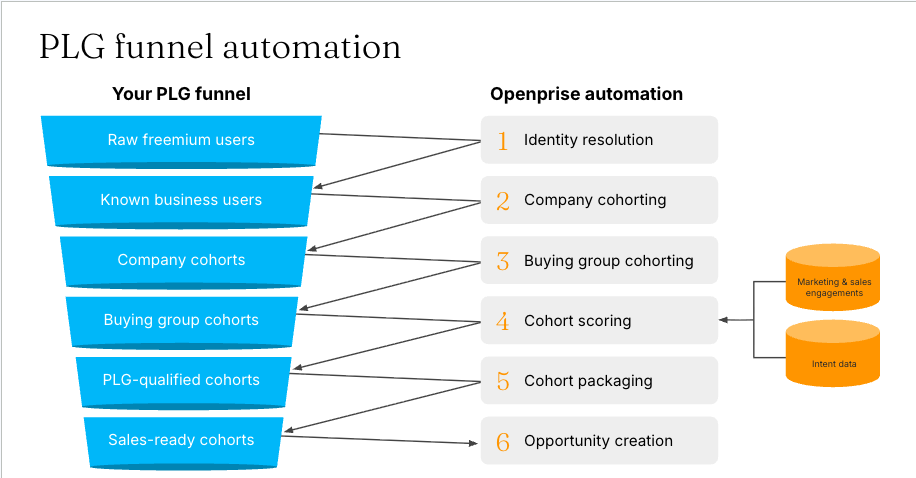
The six-step PLG funnel Openprise automates
1. Identity resolution
Openprise resolves raw freemium users to known business identities, including users who signed up with personal email addresses.
2. Company cohorting
Once identities are resolved, Openprise groups users by company.
Six disconnected users become one account with visible product traction.
3. Buying-group cohorting
Openprise groups users by role, persona, business unit, geography, or other criteria to show where adoption is taking hold inside the organization.
4. Cohort scoring
Openprise combines product activity with ICP fit, marketing engagement, sales activity, intent data, firmographics, and opportunity history.
The result is a fit-plus-behavior score that reflects commercial readiness, not just product activity.
Using centralized segmentation also means the same definitions can be applied across your warehouse, CRM, MAP, analytics, and routing workflows.
5. Cohort packaging
Once a cohort qualifies, Openprise packages the context sales needs: known users, product behaviors, company information, buying-group coverage, missing decision makers, account ownership, and recommended next action.
Sales receives a coherent opportunity story rather than a mysterious score attached to a record with three blank fields.
6. Opportunity creation
Sales-ready cohorts are routed into the CRM and MAP according to your territory, ownership, customer, opportunity, and business rules.
Lower-priority users remain in nurture or continue developing product activity without cluttering sales systems.
PLG at scale: How Vimeo uses Openprise to run its PLG motion
Vimeo’s environment included 130 million PLG users in Snowflake, 32 million active users, and 2 million enterprise prospects in Marketo.
The problem was not a lack of product data.
There was an ocean of it. The problem how to make that data useful to enterprise marketing and sales.
Openprise cross-linked Vimeo’s PLG and enterprise databases, connecting product usage with identity, marketing engagement, and account data. Product activity could become actionable pipeline instead of sitting in Snowflake looking interesting.
Read the full Vimeo PLG customer story.
What are some real-world PLG examples?
Slack lets teams begin collaborating and invite coworkers before purchasing an enterprise plan. Adoption spreads from individual users to teams and eventually to the wider company.
- Dropbox builds distribution into file sharing. Every shared folder introduces another person to the product through a useful interaction.
- Calendly turns every scheduling link into a tiny product demo. The recipient experiences the value before creating an account.
- Canva lets individuals create something useful immediately, then expands through sharing, collaboration, approvals, and brand management.
The common thread is not simply “they have a free plan.”
The product creates value and naturally brings more people into the experience.
Is PLG right for your SaaS company?
PLG works best when:
- Users can reach value quickly.
- The product can be used without significant assistance.
- Individual adoption can spread to teams or departments.
- The economics support free or trial usage.
- Your data infrastructure can handle the volume.
That final requirement tends to arrive as a surprise.
Before launching a massive self-service motion, make sure you can resolve identities, group users by company, detect buying-group traction, combine usage with fit and intent, keep low-value volume out of the MAP, and route sales-ready cohorts quickly.
Otherwise, the product may be leading growth while the rest of the organization follows several miles behind carrying a spreadsheet.
The bottom line
Product-led growth puts the product at the beginning of the customer relationship.
It can lower acquisition friction, create stronger intent signals, reveal new market segments, and give enterprise sales access to accounts that already know and use the product. But the product does not hand sales a perfectly packaged opportunity.
It hands your company a large, messy stream of freemium users and unclear behavioral data.
The companies that win with PLG are the ones that can turn that stream into a clear signal: These users belong together. This company fits. This buying group has traction. This account is ready. Do something now.
Openprise resolves the users, builds the cohorts, combines product and GTM signals, scores readiness, and routes the right opportunities into sales and marketing.
Because your PLG database should be a revenue engine. Not a very expensive storage unit for Gmail addresses.
See how Openprise turns product activity into sales-ready pipeline. Request a demo.