Claude can write your executive dinner invitation in seconds. Easy enough. But can it find 30 prospects near your Seattle venue who match your target roles and industries, then turn them into a ready-to-use guest list?
Now we're talking about AI that can actually move a campaign forward.
This means AI needs to work with real customer data, job titles, locations, and account relationships. And if you want those people added to a campaign, your chatbot needs a way to work with the systems behind it.
That's the real opportunity for AI in GTM. We've already covered AI's last-mile problem and how Claudeforce is making Salesforce accessible through Claude. The next step is making more of the GTM work that happens across your stack available through that same conversational experience.
With Openprise MCP Factory, GTM teams can connect AI chatbots to prepared business data and automated workflows, turning everyday requests into actions without having to navigate multiple systems.
Here are four ways to put it to work.
What is Openprise MCP Factory?
Our MCP Factory gives AI assistants like Claude and ChatGPT access to your Openprise data and workflows through Model Context Protocol (MCP), an open standard for connecting AI applications to external tools.
Think of it as a toolbox for your AI chatbot.
You give it access to the relevant customer and account data, plus configured workflows for tasks like creating contacts, matching accounts, or updating CRM records. Reusable AI skills tell the chatbot how to use those tools, while Openprise handles the underlying business rules.
So instead of teaching Claude the finer points of your Salesforce configuration, you give it a tool that already knows what to do.
Here's what that makes possible.
What can GTM teams do with Openprise MCP Factory?
GTM teams can build self-service AI tools for the work they do every day, from creating targeted campaign audiences and adding contacts to the CRM to analyzing customer data and investigating lead assignments.
Ops builds the underlying datasets and workflows in Openprise, then makes them available through AI chatbots so Growth, Demand Gen, and Sales can launch campaigns, follow up with buyers, and make decisions faster.
1. Build an event guest list without the spreadsheet marathon
You've booked the restaurant. Sales is on board. Now you need 30 or so of the right people in the room.
Let's say you're hosting an executive dinner in Seattle. You want current customers within 50 miles of the venue, at director level or above, working in Sales or Marketing at technology companies.
That's a fairly specific audience. And depending on how your CRM is organized, it can take some work to assemble.
With MCP Factory, your field marketing manager can ask Claude:
Build a list of customer contacts within 50 miles of our Seattle dinner location. Include directors and above in Sales and Marketing at technology companies. Export the results as a CSV.
Claude can search a prepared customer dataset through Openprise, apply the criteria, and return the matching records.
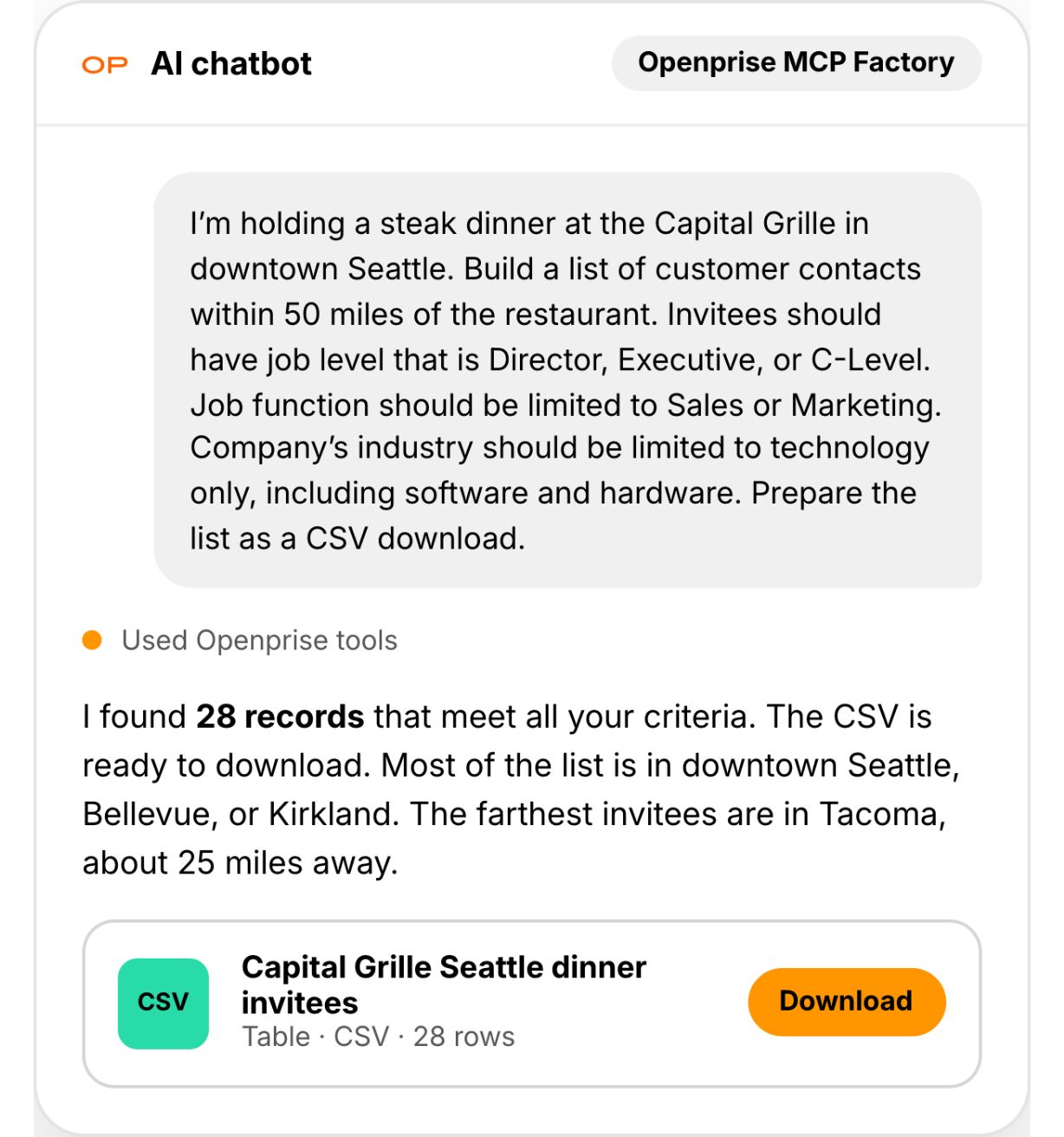
Need to expand the radius? Limit the audience to executives? Focus on software companies? You can refine the list in the same conversation.
For Growth and Demand Gen teams, this opens up a faster way to build audiences for events, ABM campaigns, and targeted outbound programs.
And here's where the business value adds up. When audience preparation takes less time, teams have more flexibility to launch campaigns, test new segments, and respond to opportunities while they're relevant.
The faster you can get the right audience into a campaign, the sooner that campaign can start generating pipeline.
2. Add new contacts to Salesforce without touching a spreadsheet
Here's a familiar conference scenario. A seller has a great conversation, exchanges business cards, and promises to follow up.
The next step should be pretty simple: get that person into the CRM, connect them to the right account, and make sure they receive the appropriate follow-up.
With MCP Factory, a seller could share a business card with Claude and say:
Add this person to Salesforce and include them in our post-conference follow-up campaign.
With the appropriate workflows configured, Openprise can handle the matching, validation, record creation, and campaign updates.
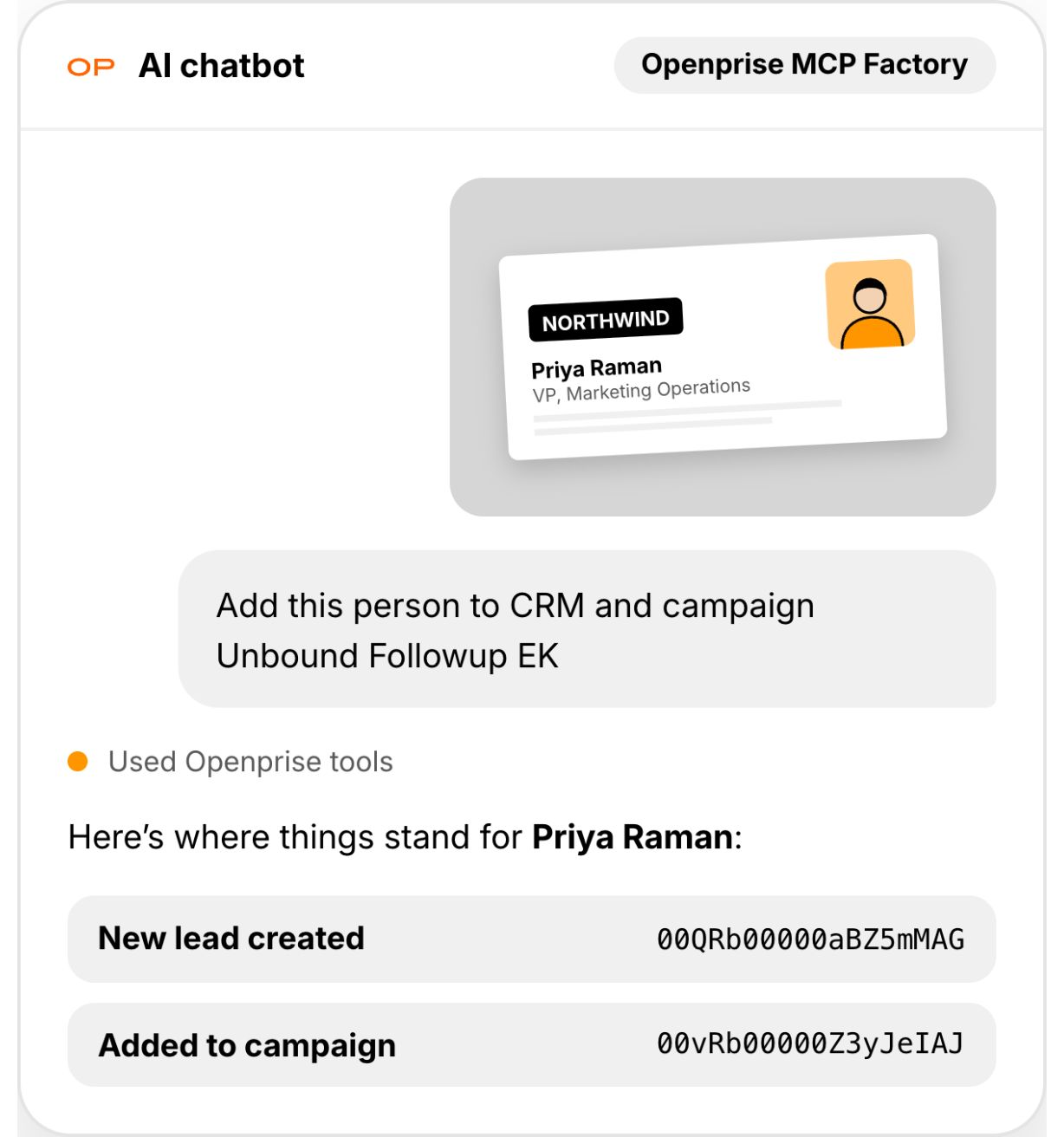
And we have a working demo that shows the core process in action.
In the MCP Factory demo, Claude starts by researching Openprise's leadership page and organizing the information into a table. The user then asks it to create contacts in Salesforce.
Claude uses an Openprise-powered skill called "add contact to account." The skill finds the relevant customer account and calls a configured Openprise workflow, which handles field mapping and record ownership.
The result? Two new contacts created and attached to the correct CRM account.
The interesting part is what Claude didn't have to figure out. It didn't need to interpret hundreds of CRM fields or work out the company's account ownership rules. Those instructions were already built into the Openprise workflow.
For GTM teams, that means AI can help capture and organize new relationships while automation takes care of the repeatable steps that make those records useful.
And when new contacts are available for follow-up sooner, Sales has a better opportunity to turn a promising conversation into an actual opportunity.
3. Get the numbers you need without building another report
It's QBR week. Someone asks how many healthcare customers you have in New England.
Reasonable question. But answering it can involve more digging than anyone wants to do during a planning meeting.
First, you need to know which accounts qualify as customers. Then how healthcare is classified, which states belong to the region, and whether you're counting parent companies or individual business units.
Now imagine asking Claude:
How many healthcare customers do we have in New England? Show me a breakdown by company size.
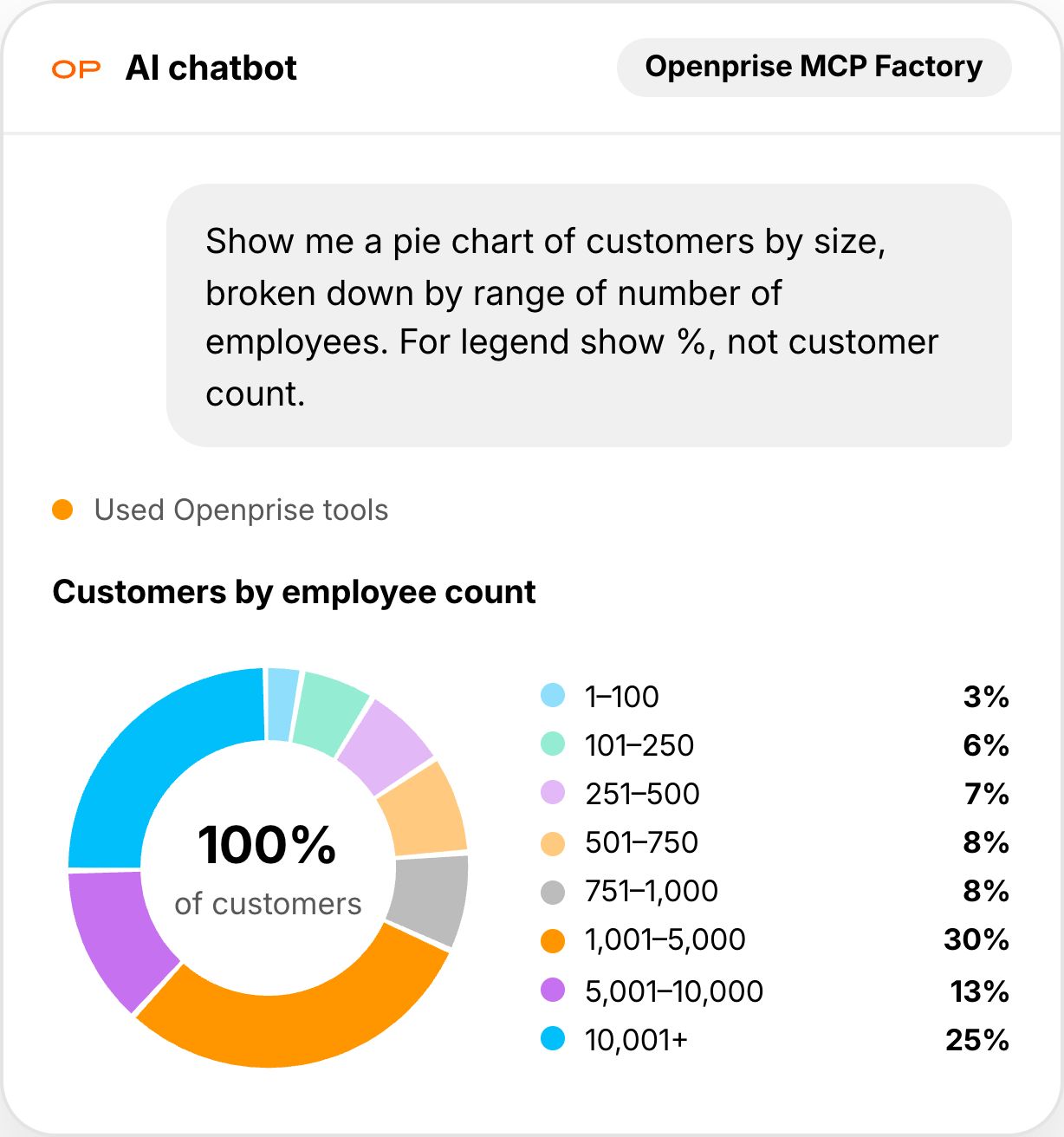
With MCP Factory, Claude can query a prepared customer dataset and use the results to generate an analysis or chart.
This is where the data preparation behind MCP Factory really earns its keep.
In the contact-creation demo, Openprise gives Claude a customer dataset containing a few thousand records and roughly 10 easy-to-understand fields. The underlying CRM account object has about half a million records and hundreds of fields.
That's quite a difference.
Instead of making AI work through an enormous CRM schema every time someone asks a question, Openprise can provide a smaller, more useful view of the business.
And that matters well beyond customer counts.
Growth teams can explore which customer segments deserve more attention. Sales leaders can investigate expansion opportunities. Revenue leaders can get a clearer view of the data behind investment decisions.
The payoff is more time spent deciding what to do with the information, and less time assembling it.
4. Find out why a lead went to that rep
A qualified lead comes in and gets assigned to a seller.
Then someone asks:
Why did this lead go to them?
Was it the territory? Company size? An existing account relationship? Some combination of the three?
Anyone who's worked with lead routing knows the answer can involve several layers of business logic.
With MCP Factory, you can make the relevant ownership information and routing history available to your chatbot.
Then ask:
Who owns this lead, when was it routed, and why was it assigned to that rep?
Claude can retrieve the available routing details, including the assigned owner, territory, relevant account attributes, and rule behind the assignment.

That's useful for several reasons.
Demand Gen can see where qualified leads are landing. Sales can confirm ownership before following up. RevOps can investigate routing decisions and identify places where the process could be improved.
And when an assignment needs attention, the team has a faster way to understand what happened and decide what to do next.
Better visibility into lead ownership helps keep qualified demand moving toward the right seller, instead of losing momentum during the handoff.
Get more from your AI investment with better data and the tools to turn answers into action
The four examples above look like different tasks, but they share the same foundation.
Your chatbot needs data it can understand and tools it can use to complete the work.
That's what Openprise provides.
First, it prepares the data. Matching, deduplication, enrichment, and standardization help create useful datasets that reflect how your business actually operates. This gives AI clearer context without making it reconstruct complicated CRM relationships on every request.
Then there's the execution layer. Openprise workflows can enforce the rules that matter to your business, from assigning the right account owner to validating required fields. MCP Factory exposes configured, API-enabled workflows to the chatbot, with access managed through administrator-controlled keys.
And reusable AI skills help turn those tools into processes people can use conversationally.
It's a useful division of labor. AI handles research, natural language, and reasoning. Openprise handles the data preparation and repeatable execution.
The result is a more practical way to extend AI across your GTM stack, using the data, systems, and processes you've already invested in.
So, what should you ask your chatbot to do first?
Start with something your team does all the time.
Maybe it's building targeted lists for field events. Maybe it's getting new contacts into Salesforce while they're still fresh. Or maybe it's answering the questions that come up every time someone looks at a pipeline report.
The best starting point is a task with a clear business outcome and a process you can make reusable.
Get one working, measure what it changes, and build from there.
Because there's a big difference between AI telling you how to do something and AI helping you get it done.
Want to see what MCP Factory could do for your GTM team? Book a demo and explore how to turn everyday requests into faster campaign execution, better sales productivity, and more opportunities to grow pipeline.